BRAND NEW: Our Impact Report for 2024-2025 is out now! See what we’ve been working on over the previous year.

Healthy Streets Approach

What are healthy streets?

Healthy streets refer to streets and neighbourhoods that enable us to walk and cycle safely.

The design of the streets around us can either support and encourage us to walk or cycle as part of our daily routine, or present barriers.

Think about it! If you live somewhere with cycle lanes and a safe speed limit, you’re probably more likely to want to cycle than if you live by a busy main road with no safe cycle lanes.

People’s choices to walk and cycle places are shaped by their environment. People will not cycle or walk in streets where they do not feel safe or welcomed.

woman cyclist in healthy streets cycle lane

In this way, the design of our streets can have a very real impact on our physical health.


The Healthy Streets Approach

The Healthy Streets Approach has the potential to create a shared framework and common vision across sectors including Health, Transport, Spatial Planning, Environment and Housing.  

It emphasises the importance of language. Walking, cycling and driving are all modes of transport. The Healthy Streets Approach doesn’t use the terms ‘pedestrians’, ‘cyclists’, and ‘drivers’. That’s because these words suggest three different groups of people fighting for a share of the street space.

Healthy Streets enables the designer to consider the range of health impacts of their design, and to ensure walking and cycling are prioritised, rather than just accommodated.
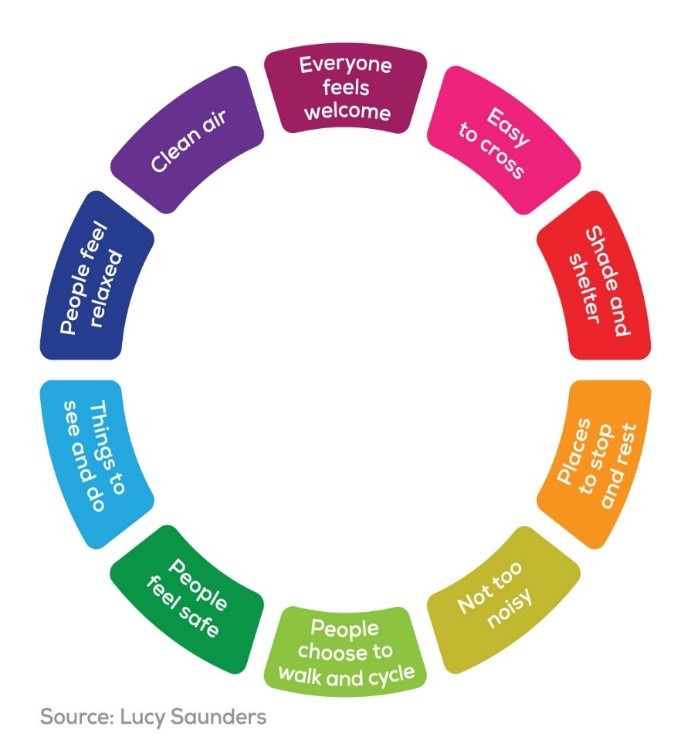
Healthy Streets Graphic

The brilliance of this approach is that by supporting the development of active streets, we are also supporting the environment and active travel, whilst creating more engagement opportunities with local businesses. This can also support economic resilience.

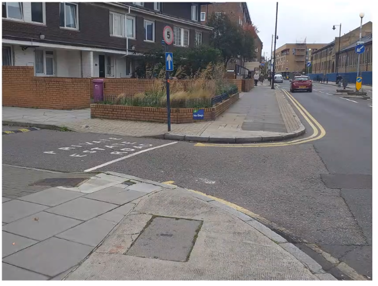
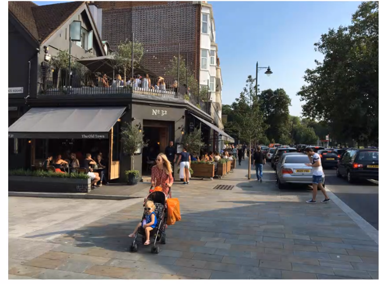
These pictures illustrate the difference between streets that are designed for cars compared to people. 
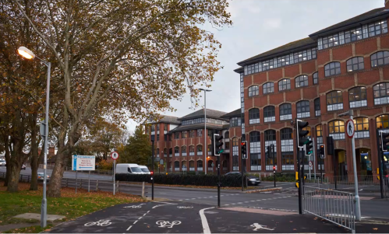
Example of a Norwich street
Don’t just show what the street looks like
People using the street
Show how people use the street
A typical road junction in the UK
The street just ACCOMMODATES people
An example of a healthy street
People are PRIORITISED on the street

Could you identify a healthy street?

As a simple exercise to try assessing a healthy street, ask yourself:

  • Imagine you had an injured leg and were walking using crutches. Is there anywhere to rest on this street?
  • If you were looking after someone else’s children, would you be comfortable cycling in the carriageway with them?
  • Imagine you were walking along the pavement with a friend. Could you comfortably walk side by side and hold a conversation?

If you answer “no” to any of these, the street design could improve to better support healthy living.

Shape overlay

Healthy Streets Training

We are collaborating with Norfolk County Council to train transport planners on how to use the Healthy Streets Approach.

Email [email protected] to find out more about how to implement the Healthy Streets Approach. Click the button below to get in touch with our Active Environments team who can help you further.

Get in touch with our team

Privacy Overview

Last updated May 2024

This website uses cookies so that we can provide you with the best user experience possible. Cookie information is stored in your browser and performs functions such as recognising you when you return to our website and helping our team to understand which sections of the website you find most interesting and useful.

This Cookie Policy explains how Active Norfolk ("Company," "we," "us," and "our") uses cookies and similar technologies to recognize you when you visit our website at  https://www.activenorfolk.org ("Website"). It explains what these technologies are and why we use them, as well as your rights to control our use of them.

In some cases we may use cookies to collect personal information, or that becomes personal information if we combine it with other information.


What are cookies?

Cookies are small data files that are placed on your computer or mobile device when you visit a website. Cookies are widely used by website owners in order to make their websites work, or to work more efficiently, as well as to provide reporting information.

Cookies set by the website owner (in this case, Active Norfolk) are called "first-party cookies." Cookies set by parties other than the website owner are called "third-party cookies." Third-party cookies enable third-party features or functionality to be provided on or through the website (e.g., advertising, interactive content, and analytics). The parties that set these third-party cookies can recognize your computer both when it visits the website in question and also when it visits certain other websites.


Why do we use cookies?

We use first- and third-party cookies for several reasons. Some cookies are required for technical reasons in order for our Website to operate, and we refer to these as "essential" or "strictly necessary" cookies. Other cookies also enable us to track and target the interests of our users to enhance the experience on our Online Properties. Third parties serve cookies through our Website for advertising, analytics, and other purposes. This is described in more detail below.


How can I control cookies?

You have the right to decide whether to accept or reject cookies. You can exercise your cookie rights by setting your preferences in the Cookie Consent Manager. The Cookie Consent Manager allows you to select which categories of cookies you accept or reject. Essential cookies cannot be rejected as they are strictly necessary to provide you with services.

The Cookie Consent Manager can be found in the notification banner and on our website. If you choose to reject cookies, you may still use our website though your access to some functionality and areas of our website may be restricted. You may also set or amend your web browser controls to accept or refuse cookies.

The specific types of first- and third-party cookies served through our Website and the purposes they perform are described in the tabs below (please note that the specific cookies served may vary depending on the specific Online Properties you visit)